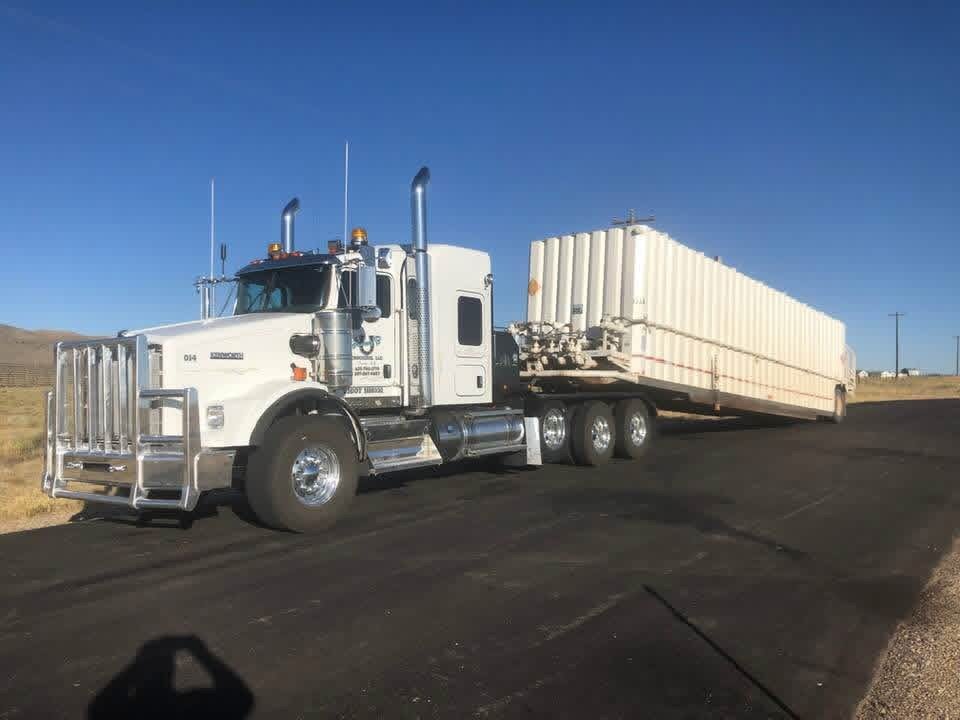
Why access decides more than people expect
You know your property from the seat of a car or a pickup. A truck carrying gravel, a trailer carrying a machine or a winch truck coming for a tank is a different animal. It is wider, longer and taller, it swings wide on a turn, and it cannot wriggle out of a tight spot the way a pickup can.
That gap between what you drive and what we drive is where trouble starts. An entrance that has never given you a second thought can be the one thing that stops the job. The good news is that every part of it can be checked ahead of the day, on foot, with nothing more than your eyes and a tape measure if you have one.
Walk it from the road
Start where the truck will leave the road and walk the whole path to where the load is going, or to where the load is sitting now. Do the same at the other end of the trip if you can get there. Go slowly and look at three things: how wide the path is at its narrowest, how sharply it bends, and what hangs over it.
Take note of whatever would make you stop and think if you were pulling a long trailer. A mailbox post near the entrance, a ditch on the inside of a bend, a parked vehicle that is always in the same place, a stack of materials beside the track. Each of them can be a problem when the truck meets it without warning.
Gates
Look at the gate fully open, and judge the clear opening between the posts instead of the length of the gate itself. Posts, hinges and latches all eat into the space. If the gate swings, check that it can be pushed all the way back and will stay there. If it slides or lifts, check that it opens the whole way.
Then look at the approach. A wide gate that the truck has to enter at an angle is tighter than it looks, because a long vehicle needs to be lined up straight before it goes through. If the road outside is narrow, or the gate sits right on a bend, say so. And if the gate is kept locked, make sure someone will be there to open it on the day.
Corners and turns
A trailer does not follow the truck around a corner. It cuts across the inside of the turn, so the inside edge of every bend is where the damage happens: a fence post, a tree, a culvert end, the corner of a building. Stand on the inside of each bend and picture a long trailer cutting across it.
A lowboy needs the most room here. Its deck sits low to the ground, which is what lets a tall or heavy machine ride lower, and it is a long trailer that needs space to get in, load and turn. A hump or a dip in the path is worth a mention too, because a low deck can catch on a crest that a pickup rolls over without noticing.
If the truck can get in but cannot turn around, it has to back out the way it came. That can be done, but it changes the plan, so we need to hear about it ahead of the day. The guide on getting your site ready for a truck has more on turnaround room.
Overhead lines and branches
Now walk the path again and look up. Power lines, phone lines and tree limbs all limit where a truck can drive and where a load can come off. People forget about them because they are well above a car roof. A tall machine on a trailer, or a tank being pulled onto a truck bed, puts things much higher in the air than you are used to.
Pay most attention to two places: where the path crosses under a line, and directly above where the load sits or will sit. Tell us what you see, including lines that run to a building and branches that hang over the track. You do not need to measure a line, and you should not try to. Tell us it is there so we can plan for it.
When the way in really is too tight
Sometimes the honest answer is that a truck and trailer will not fit. That is far better to learn on the phone than at the gate. There is often another way to do the job: a different spot on the property for the load, a second entrance nobody uses, a machine driven out to a place where the trailer can reach it, or a different trailer.
Each of those choices changes the job, and some change the price. How much hauling costs explains why access is one of the things a quote depends on, and what can hold up a haul covers the other things that stop a truck, soft ground among them.
What to say when you call
You do not need trucking words. Plain description works: "the gate is about as wide as two pickups side by side", "the track bends hard left just inside the fence", "there is a power line across the yard near the shop". Tell us about the narrowest point, the sharpest turn, what is overhead, and whether there is room to turn around.
Describe both ends of the trip, because a clear run at the pickup does not help if the drop-off is tight. If the load is a machine, the equipment hauling page lists what else we'll ask, and the comparison of flatbeds, lowboys and winch trucks shows how much room each one needs.
Customers in Paris, ID (Bear Lake County) and every other place we haul get the same questions, because a tight entrance is a tight entrance wherever it is. The FAQ lists what to have ready before you pick up the phone.