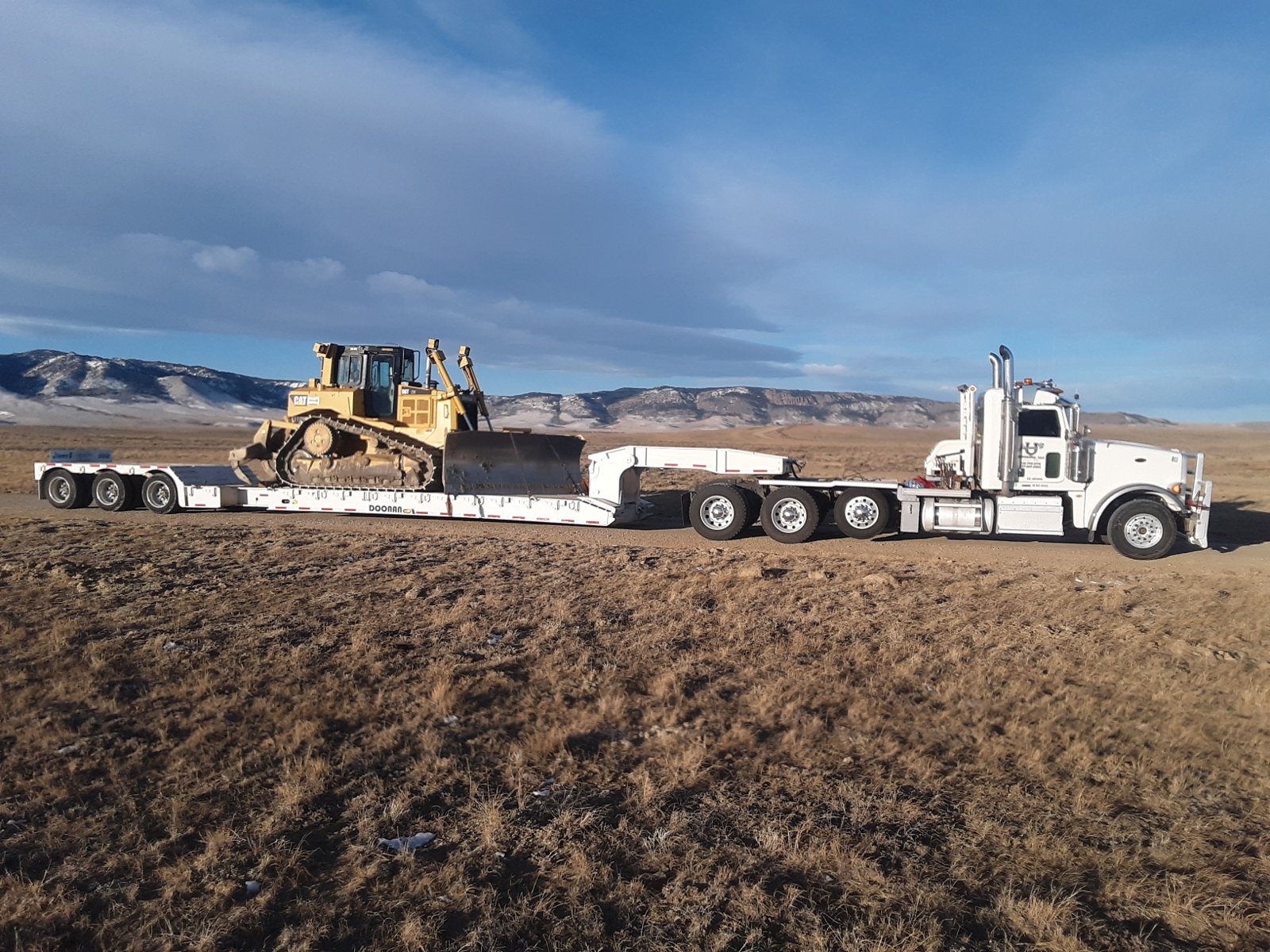
Why turnaround room matters
A car can turn around in a small space with a three-point turn. A truck with a trailer can't. It needs a lot more room, and it can't back up and maneuver the way a car can. A long trailer swings wide and cuts across the inside of every turn.
If a truck can get in but can't turn around, it has to back out the way it came. That can be done, but it is slower, harder and riskier, especially on a long or winding lane. It changes the plan, so we need to know about it ahead of the day.
What a turnaround looks like
The simplest turnaround is a wide-open yard where the truck can drive in a big loop and head back out. A large gravel pad, an open lot or a field with firm ground can all work. A circular lane is ideal.
Other properties have a spot where the truck can pull in, back up and head out again. That works too, as long as the spot is big enough, firm enough and clear of obstacles. The more room, the better.
How to check your property
Walk the property and look for the biggest open space near where the load will go. Is it big enough for a long truck and trailer to loop around? Is the ground firm? Is it clear of fences, trees, buildings, vehicles and stacked materials?
Look at the edges of the space too. A truck turning around uses all of it, and the trailer cuts across the inside. A fence post, a stump, a ditch or a rock at the edge can catch a trailer. Note anything that would be in the way.
Look up and look down
A turnaround needs clear space overhead as well as on the ground. Power lines, phone lines and branches over the turnaround can catch a tall load. Look up and note what is there. The post on tight access covers overhead lines in detail.
Look down too. A turnaround often crosses ground that isn't normally driven on: a lawn, the edge of a yard, a spot near the septic field. Mark anything buried, and check that the ground is firm. The post on what to point out before the truck arrives covers septic, wells and buried lines.
Making room
Often, the room is there but it is full. Vehicles, trailers, equipment, piles of materials and firewood all take up space a truck could turn in. Moving them before the day can turn a tight site into a workable one.
Open gates that lead to more room. Move vehicles to the side, or off the property. Clear stacked materials out of the loop. Trim back branches that hang low over the space, if you can do it without risk. Each step makes the turnaround easier.
When there is no room
Some properties don't have room to turn around, no matter what is moved. A long, narrow lane with buildings on both sides, or a dead-end lane between fences, may be one of them. That doesn't always mean the job can't be done.
The truck may be able to back in, so it can drive out forwards. The load may be able to go somewhere with more room. A machine may be able to be driven out to a spot where the trailer can reach it. Each of these changes the job, so tell us on the call.
Different trucks, different room
A lowboy is a long trailer and needs the most room. A flatbed needs a bit less. A dump truck carrying gravel and a winch truck each need their own amount. Flatbed vs. lowboy vs. winch truck explains the differences, and getting your site ready for a truck covers the other site checks.
What to tell us
- Whether there is room to turn around, and where.
- How big the space is, roughly, and what surrounds it.
- Whether the ground there is firm.
- Anything overhead or buried in the space.
- If there's no room, how long the truck would have to back up.
Access is one of the things a quote depends on, as how much hauling costs explains. Tight access can also move a date, and what can hold up a haul covers why. Call (208) 271-3641 when you've looked the site over.