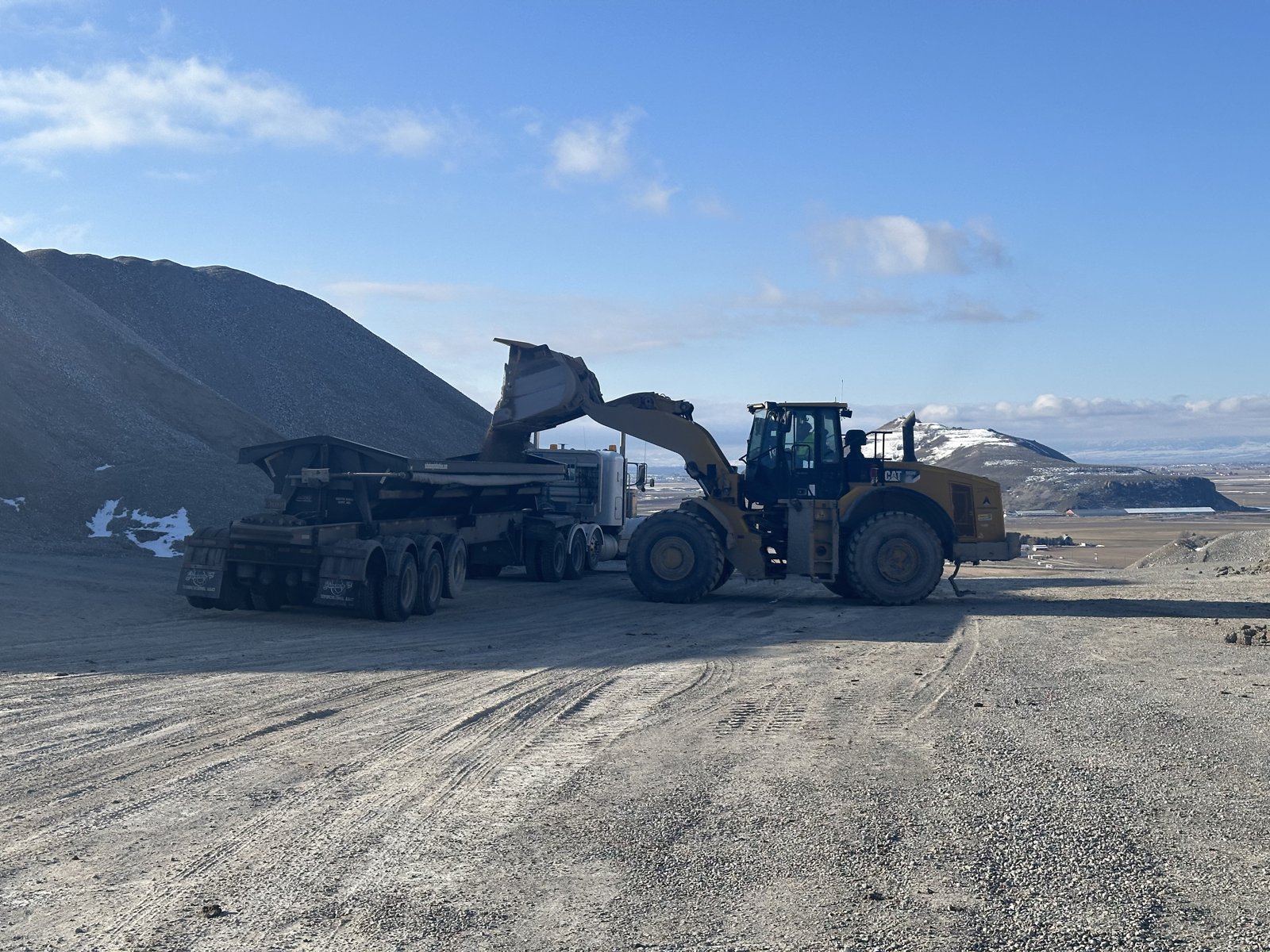
What a winch truck does
A winch truck is a truck that pulls a load up onto its bed with a winch and eases it off at the other end. It backs up to the tank, hooks a cable to it and draws the tank onto the truck. Then it drives the tank to where it is going and lets it back down.
We use our winch trucks for frac tanks, water tanks and similar heavy loads. What a winch truck does, and when you need one explains the truck in more detail.
What a crane does
A crane lifts a load straight up into the air and swings it to a new spot. It stays in one place while it works. A crane can reach over things: a fence, a building, a ditch. It can set a load down in a spot no truck could drive to.
A crane doesn't carry the load anywhere on its own. If the tank has to travel down the road, it still needs a truck. A crane is about lifting and placing. A winch truck is about pulling on and hauling.
When a winch truck suits the job
A winch truck suits a tank that sits where a truck can back up to it in a straight line, on firm ground, with nothing overhead in the way. If the truck can reach the tank and line up with it, it can pull the tank on and take it where it needs to go.
That covers a lot of tank moves: a tank on open ground beside a lane, a tank at the edge of a yard, a tank on a work site with room around it. It also covers moving a tank from one property to another, because the winch truck carries it.
When a crane may be needed
A crane may be needed when the tank sits somewhere a truck can't get to: behind a building with no way around, over a ditch, on a slope too steep for a truck, or boxed in so the truck can't line up. A crane can also be needed when the tank has to be set somewhere a truck can't reach, such as up onto a high stand.
We don't run cranes. If your job needs one, a crane company is the right call. If you aren't sure, describe the site to us on the phone and we'll tell you honestly whether a winch truck can do it.
What each needs from your site
A winch truck needs a straight path to back up to the tank, room behind the truck to work, firm ground and clear space overhead as the tank rises. A crane needs a firm, level spot to set up on, room to swing, and clear space for its boom.
Both need the ground to hold them. Both need to stay clear of overhead lines. Both need to know what is buried. The post on what to point out before the truck arrives covers septic, wells and buried lines, and getting a site ready for a winch truck covers the rest.
Questions that point the way
- Can a truck back up to the tank in a straight line?
- Is the ground firm where the truck would stop?
- Is there clear space overhead above the tank?
- Does the tank need to travel down the road, or just across the site?
- Does it need to be set somewhere a truck can't reach?
If the answers to the first three are yes, a winch truck is likely the right tool. If the tank has to be lifted over something or set somewhere a truck can't reach, a crane may be needed.
What affects the cost
For a winch truck move, the tank and its size, both spots, the room to back up, the ground, what is overhead and the miles all shape the price. How much hauling costs explains each one. Soft ground can push a tank move back, and what can hold up a haul explains why.
Next step
Flatbed vs. lowboy vs. winch truck puts our three options side by side. When you have a tank to move, call (208) 271-3641 and describe the tank and both spots. Our winch truck services page has the short version.