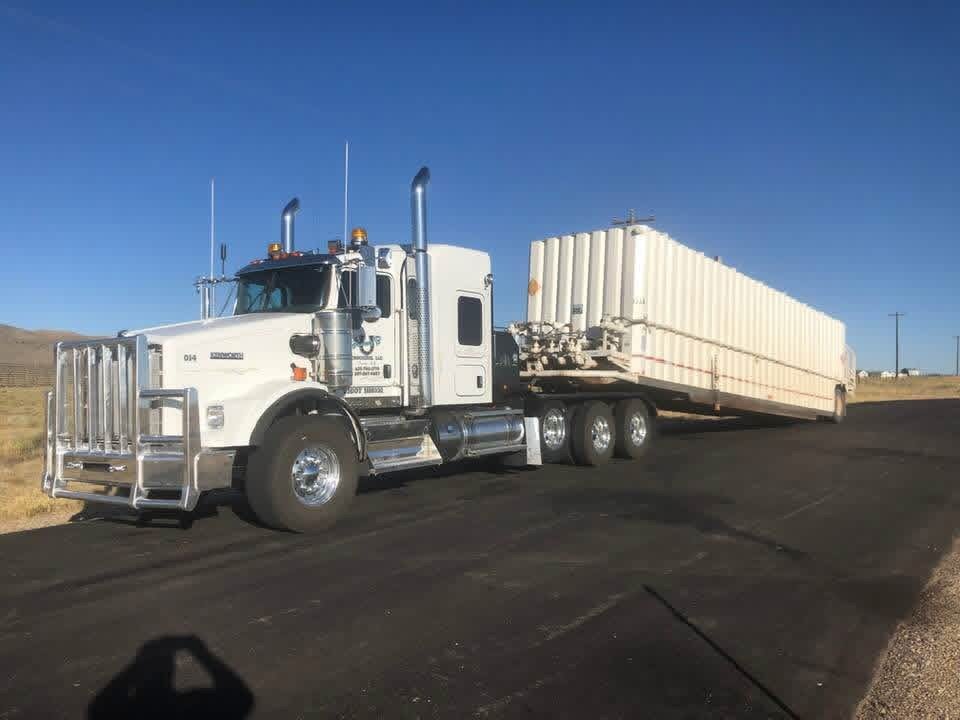
How a winch truck works on site
A winch truck backs up to the load, hooks a cable to it and pulls the load up onto its bed with a winch. At the far end, it backs into place and lets the load back down. All of that happens behind the truck, in line with the truck bed.
That tells you what the site needs: a straight approach to the load, room behind the truck to work, firm ground to hold the truck in place, and clear space above as the load rises. What a winch truck does explains the truck itself in more detail.
A straight path to the load
Stand at the load and look back toward the way in. Picture a truck backing toward you in a straight line. Is there room for it? Is anything in the way: a fence, a building corner, a tree, a parked vehicle, a pile of materials?
The truck needs to line up with the load before it starts pulling. If the load sits in a corner, between buildings or at the end of a narrow path, the truck may not be able to line up. Tell us exactly how the load sits and what is around it.
Getting in and out
Before it can back up to the load, the truck has to get onto the property and get close. Check the gate, the turns and the width of the path from the road. Once the load is on, the truck has to drive back out, now carrying the load.
If there is no room to turn around, the truck may need to back in or back out a long way. That can be done, but it changes the plan, so tell us. The post on making room for a truck and trailer to turn around covers turnaround room in more detail.
Firm ground
A winch truck holds its position while it pulls a heavy load. If the ground under it is soft, it can sink or slide. Look at the ground where the truck will stop and along the path it will take. Lawns, low spots, ground that holds water and ground that is still thawing are the places to watch.
If the ground is soft, the honest answer is often to wait. Soft ground, mud and heavy trucks explains why, and what can hold up a haul covers the other causes of delay.
Clear space overhead
As a tank comes onto a winch truck, it tips and rises. That puts the top of the tank much higher than it sits on the ground. Power lines, phone lines, tree limbs and roof overhangs above the load or above the truck's path all matter.
Look straight up from where the load sits and along the line the truck will take. Tell us what you see. Don't try to measure a power line, and don't try to move one. Telling us it is there is what lets us plan.
Nothing buried where the truck will work
Septic tanks and lines, wells, water lines and buried power are all common near tanks. A heavy truck pulling a heavy load puts a lot of weight on the ground, and anything buried under it can be damaged. Mark what you know about, even roughly. The post on what to point out before the truck arrives covers each of these.
Get the load ready
- Empty the tank, or tell us plainly what is in it.
- Disconnect pipes, hoses, wiring and anything else attached to it.
- Clear materials, equipment and vehicles away from it.
- Mark buried lines, septic and wells near the truck's path.
- Make sure the gate is open and the path is clear on the day.
- Keep people and pets well clear while the truck is working.
Do the same at the far end
The drop-off spot needs a straight approach, firm ground, clear space overhead and nothing buried underneath. Decide where the load should sit and mark the spot. Getting your site ready for a truck has a full checklist, and how much hauling costs explains how access feeds into the quote.
When the site is looked over, call (208) 271-3641 and describe both ends. Our winch truck services page has the short version.